The Ultimate 7-Day Authentic Algarve Itinerary for First-Time Visitors
If you are flying across the Atlantic from the United States or Canada for your first trip to Southern Portugal, you want to make every single day count. You are likely searching for the "real" Europe: ancient cobblestone streets, centuries-old Roman bridges, world-class seafood, and breathtaking coastlines that haven't been swallowed by massive tourist traps.
Unfortunately, many first-time visitors make the mistake of booking their entire stay in the heavily commercialized resort towns of the Central Algarve, only to find themselves surrounded by crowded English pubs and neon signs.
To experience the true soul of Portugal, you need to head to the Eastern Algarve (Sotavento). This region, stretching from the capital city of Faro to the Spanish border, has beautifully preserved its authentic fishing villages, Moorish history, and pristine barrier island beaches.
This meticulously crafted, slow-paced 7-day itinerary is designed perfectly for North American travelers. It balances historical exploration with deep relaxation, requires absolutely zero stressful driving on unfamiliar foreign roads, and guarantees you will experience the authentic Portuguese lifestyle.
🌅 The Weather Rhythm & Best Time to Visit
For North American travelers accustomed to sharp seasonal shifts, the Eastern Algarve offers a gentle, welcoming Mediterranean climate year-round. To experience the region like a true travel connoisseur, timing your trip is key:
• The Sweet Spot (May–June & September–October): Warm, golden days averaging 75°F (24°C), perfect for island hopping, beach relaxation, and alfresco dining without the mid-summer crowds.
• The Slow Summer (July–August): Ideal for dedicated beach lovers; the coastal breeze stabilizes the heat, and evenings turn into vibrant, open-air cultural celebrations under the stars.
Why the Eastern Algarve is Perfect for First-Time Visitors
The Eastern Algarve offers something that the popular western resorts simply cannot offer: authentic Portuguese life happening in parallel with your holidays. When you stroll through the morning market in Olhao, you are not watching a tourist staging. You are inside a secular tradition that continues to exist whether visitors are present or not.
Geography also plays in your favor. As the coast is protected by the Ria Formosa lagoon, the best beaches are on barrier islands accessible only by boat. That simple fact turns going to the beach, which in other areas means traffic and parking, into a true adventure. The train passes directly through the centers of the fishing villages. Ferries depart from the waterfront at regular intervals. Everything connects naturally without needing a car.
authentic Portuguese culture
walkable historic towns
peaceful beaches
incredible seafood
safe environments
relaxed Mediterranean living
For North Americans especially, this region feels like the Europe they imagined before arriving.
The slower pace, historical atmosphere and human-scale towns make the Eastern Algarve one of the easiest and most rewarding introductions to Portugal.
Days 1 & 2: Arriving in Faro — The Historic Capital
Your journey begins at Faro International Airport. Because Faro is the capital of the region, logistics are incredibly easy. In less than 15 minutes, you can grab a taxi or an Uber and be standing in the heart of the city, ready to begin your Portuguese adventure.
Day 1: Stepping Back in Time
Spend your first day adjusting to the time zone by exploring the Cidade Velha (Old Town). Enter through the monumental Arco da Vila and wander the pedestrian-only cobblestone streets. Visit the Faro Cathedral (Sé de Faro), where a climb up the medieval bell tower offers a spectacular first glimpse of the Ria Formosa lagoon. For dinner, embrace the local culture: find a quiet tasca tucked into a historic plaza and order a Cataplana (a traditional copper-pot seafood stew) paired with a crisp regional white wine.
Day 2: The Bone Chapel and Deserted Islands
Start your morning at the awe-inspiring Igreja do Carmo to visit the Capela dos Ossos (Bone Chapel). Built by monks in the 19th century from the bones of over 1,000 friars, it is a fascinating piece of local history. In the afternoon, walk down to the Faro Marina and take a 30-minute ferry ride to Ilha Deserta (Deserted Island). As the name implies, it is an uninhabited paradise of white sand, perfect for your first dip in the Atlantic.
What Makes Faro One of Portugal’s Most Underrated Cities
Unlike resort localities created on purpose, Faro has soul. It is a university city, a regional capital and a genuine community that, by chance, is located next to one of the most spectacular natural parks in Europe.
The Ria Formosa Natural Park, a strip of 60 kilometers of lagoon, barrier islands, salt pans and marshes, begins literally at the city's door. From the marina promenade, you can see flamingos feeding in the shallow waters and hear the call of migratory birds that traveled thousands of kilometers to spend the winter here. The historic center brings together Roman foundations, Moorish walls, an active cathedral and a bone chapel that seems to belong more to the Middle Ages than to the 21st century.
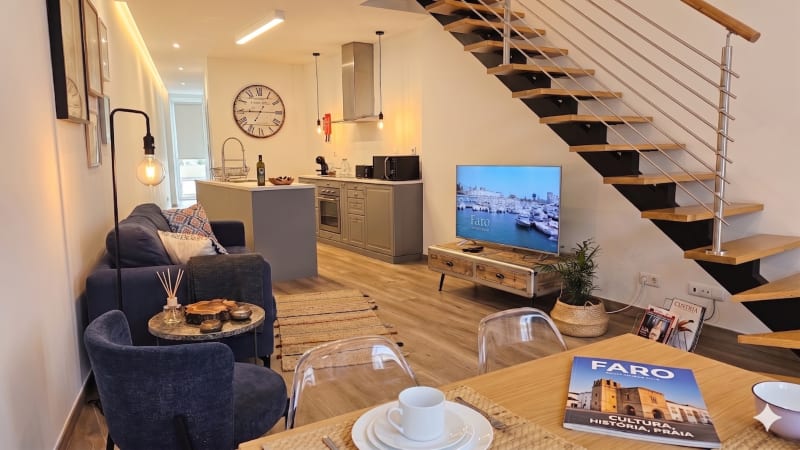
As for accommodation, our Casa da Mouraria is inside the historic center itself, a few minutes on foot from the marina and the ferry docks, being the ideal base to explore everything on foot.
Days 3 & 4: Santa Luzia — The Octopus Capital and Pure Relaxation
On day 3, take a cheap and highly scenic 40-minute regional train ride east from Faro to the Tavira region, and settle into the sleepy, picturesque fishing village of Santa Luzia.
Day 3: Embracing the Slow Life
Santa Luzia is the antidote to the modern, fast-paced world. Known across Portugal as the capital of octopus, the village waterfront is lined with colorful, traditional fishing boats. Spend your afternoon walking the paved boardwalk. For dinner, dining here is mandatory: order Polvo à Lagareiro (octopus roasted in premium olive oil and garlic) at a waterfront restaurant while watching the sun set over the lagoon.
Day 4: The Secret Beach of Terra Estreita
Today is dedicated to absolute tranquility. Walk out of your accommodation and hop on the small, wooden ferry boat that departs directly from the Santa Luzia avenue. In 10 minutes, you will arrive at Praia da Terra Estreita. Because it is only accessible by boat, this pristine beach remains incredibly uncrowded. Rent a sunbed, read a book, and enjoy the gentle sounds of the ocean.
Why Travelers Fall in Love with Santa Luzia
There is a very particular quality of light in Santa Luzia at the end of the afternoon that no photograph has really managed to capture. The village faces west over the lagoon and, when the sun starts to go down, the water becomes golden, then coppery, then a deep pink that lasts for an almost impossible amount of time.
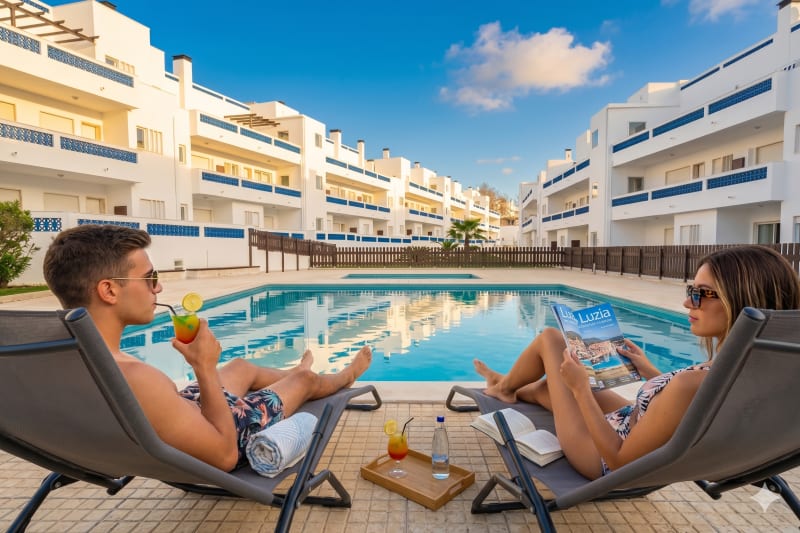
The village itself does not have noteworthy tourist infrastructure. There is no hotel, no souvenir shop, nor guided walking tours. What exists is a waterfront lined with fishing boats, a handful of seafood restaurants where the chef may very well be the fisherman who caught your lunch that morning, two excellent bakeries, a community pool open in summer, and the Santos Apartment, our property designed in detail, which opens directly to this riverside universe and allows guests to live temporarily as locals, instead of only passing through as tourists.
Days 5 & 6: Tavira’s Roman Heritage and the Anchor Cemetery
Santa Luzia makes the perfect base for exploring the surrounding historical wonders without having to pack and unpack your bags.
Day 5: The Romance of Tavira
Rent a bicycle or take a 5-minute Uber ride into the heart of Tavira. Often called the most beautiful town in the Algarve, Tavira boasts 37 historic churches and a stunning Roman bridge that spans the Gilão River. Walk through the lush public gardens, explore the ruins of the Moorish Castle for panoramic views of the "tesoura" (scissor) rooftops, and enjoy a slow, multi-course lunch in a riverside café.
Day 6: Praia do Barril and the Anchor Cemetery
Take a morning walk or cycle from Santa Luzia to the nearby Pedras d'El Rei. Here, you will board a vintage miniature train that takes you across the salt marshes to Praia do Barril. This spectacular, wide beach is famous for the Cemitério das Âncoras (Anchor Cemetery)—a memorial of hundreds of rusted anchors placed in the sand dunes, honoring the region's historic tuna fishing industry. It is a hauntingly beautiful spot for photography.
Tavira: The Most Elegant Town in the Algarve
Ask any architect or photographer who has spent time in the south of Portugal which Algarve locality they like most, and the answer is almost always Tavira.
The town has an architectural coherence that the most popular resort destinations lost long ago to excessive development. The scale of the buildings is human. The streets are narrow enough to offer shade in summer without becoming claustrophobic. The river lives with the movement of traditional wooden fishing boats. And everywhere, on doors, on church facades, on the walls of old manor houses, the characteristic Portuguese azulejo creates a visual language that is unique and explicitly local.
Tavira also has an increasingly sophisticated gastronomic and wine scene. The Alentejo wine region starts just to the north, and the local seafood, in particular red mullet and cuttlefish, is prepared with a simplicity that respects the ingredient and does not try to impress with unnecessary complexity.
Day 7: Olhão’s Markets and a Farewell Sunset
Keep the last day for Olhao, the locality with the most distinctive architecture in the Eastern Algarve. While Faro and Tavira rely heavily on Roman and Moorish heritage, Olhao has a North African feel: cubic houses with flat roofs, whitewashed walls and a tangle of narrow alleys that reflects the town's historical trade links with Morocco.
The morning markets for fish and fresh produce in Olhao, two red-brick pavilions right next to the waterfront, are among the best in Portugal. Arrive by 9am and you will find all the drama of a fishing port in full activity: silver fish shining on ice, vegetables and herbs stacked in vibrant pyramids, and the smell of salt, sea and freshly made coffee coming from nearby stalls.
After the market, take a ferry around midday to one of the barrier islands off Olhao, Ilha da Culatra or Ilha do Farol, for one final swim in the Atlantic. Return to Faro at the end of the afternoon, still with time for one last walk around the old city walls before departure. If the light is right, and in the Algarve the light is almost always right, the final memory of this week will be the Ria Formosa tinted pink and gold as the sun falls into the Atlantic one last time.
A Perfect Final Day in Portugal
The final day of a journey often becomes the most emotional. After a week immersed in the rhythm of the Eastern Algarve, many travelers begin to notice small things they had stopped seeing at home: the silence of the mornings, the absence of stress, the quality of long meals, the friendliness of everyday interactions.
The Eastern Algarve leaves an impression not through spectacle, but through atmosphere. That is what makes people return.
🚆 Why This Algarve Itinerary Works So Well Without a Car
One of the great practical advantages of the Eastern Algarve is that the whole region was made to be explored without a car. The CP regional train, the Algarve Line, connects Faro, Olhao, Fuseta, Tavira and the intermediate villages with several daily services. Fares are affordable, Faro-Tavira costs less than 4 euros, and the train crosses directly through the historic centers instead of stopping in the industrial outskirts.
Ferries connect the mainland to the barrier islands from several boarding points: Faro marina, Santa Luzia waterfront, Tavira riverbank, Fuseta and Olhao. Most crossings take less than fifteen minutes and cost between 3 and 5 euros round trip.
For longer distances or late returns, Uber and local taxis are easy to find and cheap by European standards. A bicycle in Santa Luzia or Tavira allows you to cover the entire Ecovia do Litoral at your own pace.
❓ Frequently Asked Questions (FAQ)
Is 7 days enough for the Algarve?
Seven days is the perfect amount of time to comfortably explore the Eastern Algarve without feeling rushed. It allows you to split your time between the cultural history of Faro and the peaceful beach lifestyle of the Santa Luzia/Tavira area.
Do North Americans need to rent a car?
No! One of the biggest advantages of this specific itinerary is that it is 100% car-free. Driving in a foreign country can be stressful. The Eastern Algarve features an excellent, cheap regional train network, plentiful Ubers, and pedestrian-friendly towns.
Is the Algarve safe for tourists?
Portugal consistently ranks as one of the top 10 safest countries in the world. The Eastern Algarve is exceptionally safe, with very low crime rates. It is incredibly welcoming for solo travelers, couples, and families alike.
What is the best month to visit the Algarve?
May, June, September and October offer the best balance between weather and fewer crowds.
Is the Eastern Algarve crowded?
Compared to Central Algarve resorts, the Eastern Algarve remains much quieter and more authentic.
Can you do Algarve without speaking Portuguese?
Yes. English is widely spoken across Faro, Tavira and the tourism sector.
Why do travelers prefer Tavira over Albufeira?
Tavira offers a more authentic, elegant and peaceful Algarve experience focused on culture and nature rather than nightlife tourism.
What is the best base for a first visit?
Faro in the first two nights, to make arrival easier and explore the Old Town, and then Santa Luzia for the central phase of the trip. Both offer excellent access to the region by train, ferry and bicycle.
Is the Eastern Algarve suitable for families with children?
Without a doubt. The barrier-island beaches are safe and not very crowded, the ferries are fun for the little ones, and localities like Santa Luzia and Tavira are calm and easy to walk through. Santos Apartment, in Santa Luzia, has a shared pool and direct access to the waterfront.
✨ The Authentic Algarve Experience
The Eastern Algarve is not about rushing from attraction to attraction. It is about experiencing Portugal slowly. Morning coffees in historic plazas. Fresh seafood lunches beside the lagoon. Long walks through whitewashed streets. Sunsets over barrier island beaches. This slower rhythm is what transforms a simple holiday into a meaningful travel memory.
🏡 Recommended Stays for a Flawless 7-Day Itinerary
To execute this 7-day itinerary flawlessly, splitting your stay between two strategic bases is the ultimate travel hack. Algarve Stay Homes offers the perfect combination for your Portuguese adventure.
For Days 1 & 3: Start your trip at Casa da Mouraria, located directly in the historic center of Faro. You will be steps away from the Old Town, the train station, and top restaurants, making your arrival logistics incredibly smooth.
For Days 4 to 7: Move to our Santos Apartment in the quiet fishing village of Santa Luzia. Offering 24-hour security, a private garage, and a gorgeous community pool, it is the perfect luxury base for exploring Tavira and the spectacular island beaches.
Both properties comfortably accommodate 1-4 guests. Book your authentic European escape directly with us today.
Where to stay
Our Algarve Homes
Stay close to everything you explored in this guide.